Inspired by Centenarians: Engineering Stem Cells to Reverse Aging in Primates
A 44-week primate study reports that gene-edited human stem cells turned back aging clocks across many tissues.

There are people who live past 100 in good health, and then there are the rest of us. For decades, longevity researchers have asked what centenarians carry that the rest of human biology does not. Part of the answer appears to lie in a gene called FOXO3.
In 2025, a team led by Guang-Hui Liu, at the Chinese Academy of Sciences reported in Cell (Lei et al., 2025) that it had taken that insight a step further in the laboratory. The researchers engineered human stem cells to carry a constantly active form of FOXO3, infused them into elderly macaques every two weeks for 44 weeks, and tracked signs of biological rejuvenation: better performance on a memory task, denser bone, restored reproductive markers, and aging clocks across many tissues that, on average, ran backward.
Several outlets compressed this into headlines about reversed aging. The study itself is more measured, and more interesting. The authors describe their results as initial evidence: a starting point, not a finished therapy.
The longevity gene from centenarians
In human longevity genetics, two genes keep resurfacing: APOE and FOXO3. Across Okinawan, German, and other long-lived cohorts, a common variant of FOXO3 has been associated with reaching exceptional age (Willcox et al., 2008; Flachsbart et al., 2009). Carriers of the protective version show roughly double the odds of living into the mid-90s in some studies. FOXO3 acts as a master switch for stress resistance, DNA repair, and antioxidant defense, and centenarians appear to keep that switch engaged a little longer than most people.
The researchers did not try to recreate the centenarian variant. They engineered something stronger. In ordinary cells, FOXO3 is switched off by AKT, an enzyme that tags two specific sites on the protein and exiles it from the nucleus. Using gene editing, the team altered those two sites so AKT can no longer tag them. FOXO3 stays in the nucleus and keeps doing its protective work. The lab first introduced this edit in 2019 (Yan et al., 2019) and has now carried it into mesenchymal progenitor cells it calls SRCs, for senescence-resistant cells.
In other words, centenarian genetics did not hand the team an answer. It told them where to look.
What the study reported
The trial focused on the oldest animals in the study: cynomolgus monkeys aged 19 to 23 years, roughly equivalent to humans in their late fifties to sixties. The animals were divided into three groups (saline, ordinary wild-type mesenchymal cells, and the FOXO3-engineered SRCs), with each animal receiving an intravenous infusion every two weeks for 44 weeks, a span the authors equate to about three human years. The readouts were broad. Bulk transcriptomic profiling covered 61 tissues across ten organ systems to build tissue-level aging clocks, while more targeted assays (cognitive testing, brain MRI, micro-CT of bone, single-cell and single-nucleus RNA sequencing, and histology) were applied to the organs where aging takes its clearest toll.
The three-group design is what gives the work its analytical strength. Comparing wild-type cells against the engineered SRCs is meant to isolate what the FOXO3 edit itself contributes, separating a general stem-cell effect from the specific benefit of the engineering.
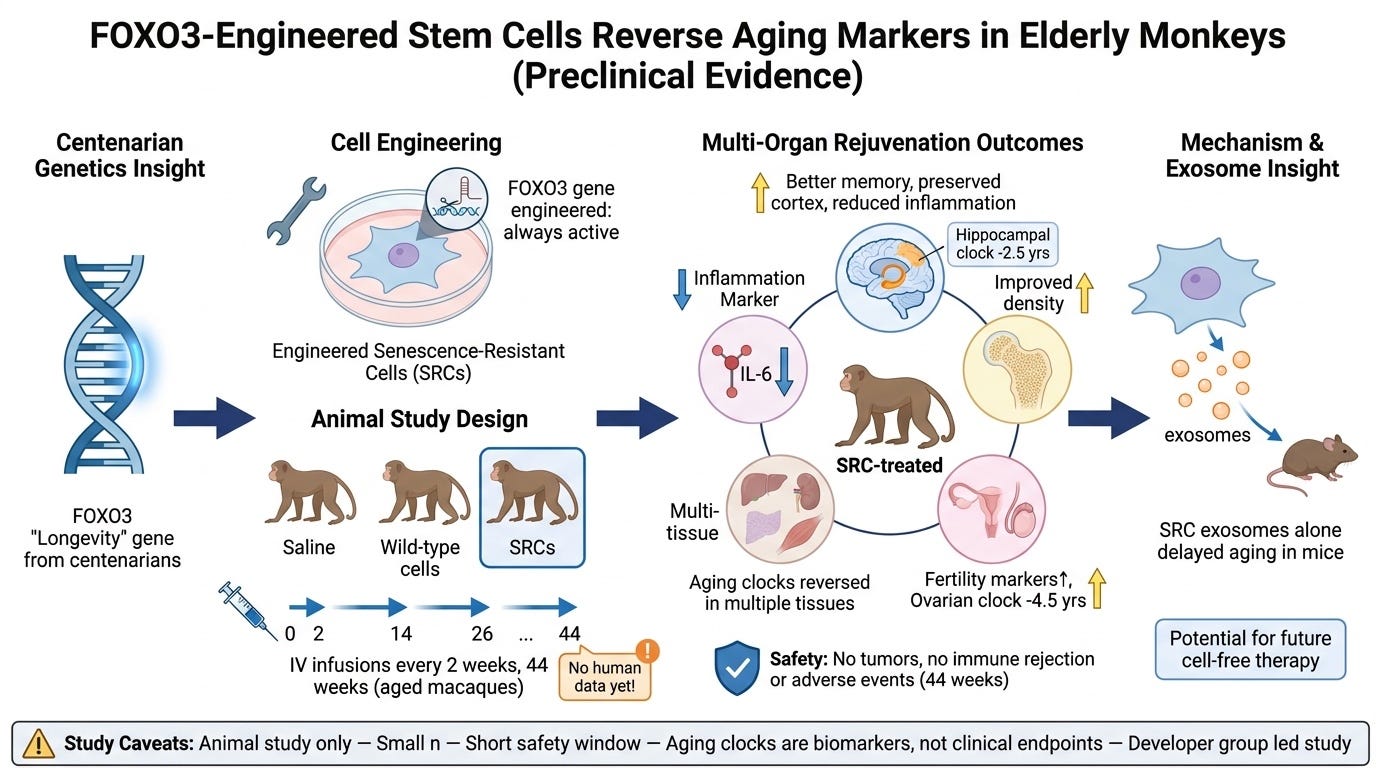
Across these measures, the authors report that the engineered cells outperformed both controls. Treated animals retrieved rewards more accurately on a memory task and, on MRI, preserved cortical thickness in the frontal and parietal lobes, alongside higher markers of myelination. Microglial activation, a sign of brain inflammation, was reduced. The single-nucleus hippocampal aging clock ran back by roughly 2.5 years on average, and about half of the transcriptomically profiled tissues showed measurable reversal. Micro-CT indicated less periodontal and trabecular bone loss, and circulating inflammatory markers such as IL-6 declined.
The reproductive system, typically among the first to decline, showed the most pronounced response. A single-cell ovarian aging clock reversed by about 4.5 years in animals treated with the engineered cells, compared with roughly 3 years for wild-type cells, and ovarian tissue carried fewer markers of senescence and cell death. In males, the treatment preserved germline stem cells and improved sperm production. Over the full 44 weeks, the authors report no tumors, no immune rejection, and no adverse events.
The exosome finding
One of the more mechanistically intriguing results is that the cells may not need to take up residence in tissues to have an effect. SRCs release exosomes, tiny membrane vesicles loaded with proteins, RNAs, and metabolites, including spermine, a polyamine with established protective effects in aging. When the researchers gave only the exosomes to old mice for about twelve weeks, the mice still showed delayed aging across liver, lung, kidney, and muscle.
If a defined vesicle can carry much of the benefit, the practical path changes. Cell therapies are difficult to manufacture, store, and dose. Exosome-based products are comparatively simpler, though, like the rest of this work, the exosome results are early and were obtained in mice.
The caveats
This is where a careful reader should slow down. The study is striking, but its limits are equally important, and the authors are candid about most of them.
It is an animal study. Every primary result comes from monkeys, with the exosome work done in mice. Nothing here has been tested in people, and primate findings do not always translate to human patients.
The groups are small. Each arm contained only a handful of animals, which is typical for primate research but limits statistical power and the ability to detect rare harms.
The safety window is short relative to the concern. Forty-four weeks is long for a primate study, but tumor risk from stem-cell-derived products can take far longer to surface. A clean safety signal over this period is encouraging, not conclusive.
The aging clocks are biomarkers, not outcomes. A reversed transcriptomic or epigenetic clock (Horvath, 2013) is a measurement of molecular age, not a demonstration that the animals will live longer or that fertility was truly restored. These are promising surrogate markers that still need to be tied to hard outcomes.
And the work was conducted by the cells’ developers. The same group that engineered the SRCs ran the study and reported the results. That is normal at this stage of a field, but it makes independent replication essential before the findings can be treated as settled.
Why it still matters
With those caveats in place, the result is meaningful. For 44 weeks, gene-edited human stem cells circulated through aged primates without tumors, immune rejection, or reported adverse events. For two decades, the most persistent objection to stem-cell-derived therapies has been tumor risk. This study offers one of the cleaner primate safety signals reported so far for an engineered, embryonic-stem-cell-derived product. It does not retire the concern, but it moves the conversation.
The conditions this line of work points toward are real: premature ovarian insufficiency, age-related cognitive decline, refractory osteoporosis, and frailty, all diseases with real patients and few good options. A therapy emerging from this lineage, whether the engineered cells, a defined exosome formulation, or a future small molecule that mimics FOXO3 activation, could eventually reach people whose conditions are now considered untreatable. Eventually is the operative word.
What comes next
Aging research is shifting from describing the problem to engineering interventions against it (López-Otín et al., 2023; Zhang et al., 2020). This study shows that a single, precise edit at a longevity gene, guided by the genetics of people who already live the longest, can produce stem cells that survive in the aged body and appear to rejuvenate it from within. The necessary next steps are clear: independent replication by groups without a stake in the product, longer safety follow-up, larger cohorts, and eventually carefully designed human trials. Some researchers will look for ways to deliver the benefit without the cells; others will work out which exosome cargoes matter most.
The centenarians have always carried something. We are still learning how to read it, and now how to test what we think we have found.
Written by Jingqi Fang and Eric Verdin
References
1. Lei, J., Xin, Z., Liu, N., et al. (2025). Senescence-resistant human mesenchymal progenitor cells counter aging in primates. Cell, 188, 5039–5061.
2. Willcox, B. J., Donlon, T. A., He, Q., et al. (2008). FOXO3A genotype is strongly associated with human longevity. Proceedings of the National Academy of Sciences, 105(37), 13987–13992.
3. Flachsbart, F., Caliebe, A., Kleindorp, R., et al. (2009). Association of FOXO3A variation with human longevity confirmed in German centenarians. Proceedings of the National Academy of Sciences, 106(8), 2700–2705.
4. Yan, P., Li, Q., Wang, L., et al. (2019). FOXO3-engineered human ESC-derived vascular cells promote vascular protection and regeneration. Cell Stem Cell, 24(3), 447–461.e8.
5. Horvath, S. (2013). DNA methylation age of human tissues and cell types. Genome Biology, 14(10), R115.
6. Zhang, W., Qu, J., Liu, G.-H., & Belmonte, J. C. I. (2020). The ageing epigenome and its rejuvenation. Nature Reviews Molecular Cell Biology, 21(3), 137–150.
7. López-Otín, C., Blasco, M. A., Partridge, L., Serrano, M., & Kroemer, G. (2023). Hallmarks of aging: An expanding universe. Cell, 186(2), 243–278.